Flagship Project

Spatial transcriptomics of the immune landscape in vitiligo skin

What I valued most in this project was the chance to work at the level of patient tissue and ask how treatment changes the immune landscape when spatial context is preserved rather than averaged away.

Patient Tissue Analysis Spatial Transcriptomics Translational Skin Biology

Overview

Why this project matters

I liked this project because it pushed me to think about disease and treatment at the scale of tissue architecture. Vitiligo is clearly shaped by immune activity in skin, but the local organization of that immune response changes with therapy and is easy to miss when everything is averaged into a bulk readout.

For me, this project matters because it sits at a useful bridge between skin biology and translational analysis. It let me ask a tissue-scale question with a method that preserves local context, which makes treatment response feel more biologically interpretable.
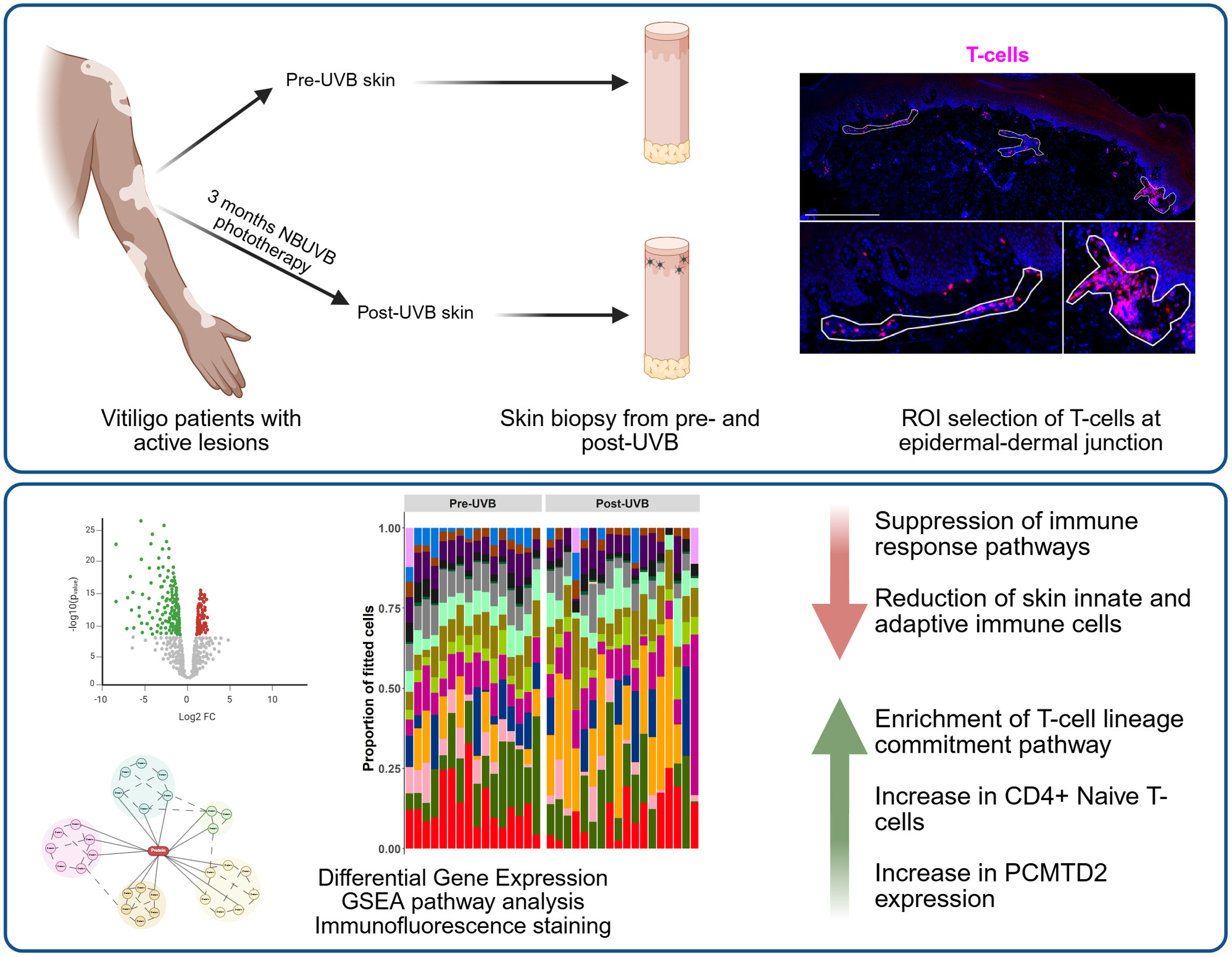

Core Questions

The questions that made the project interesting

How does treatment reshape tissue organization?

The first thing I wanted this work to clarify was how NB-UVB changes immune-state composition and spatial arrangement inside vitiligo lesions.

Why use spatial readouts?

Spatial readouts mattered because the biology depends on neighborhood, microenvironment, and local arrangement, not only on which transcripts are present.

What makes it translationally important?

What makes the work useful to me is that it ties treatment response to a tissue-resolved map, which feels much closer to how disease and recovery are actually experienced in skin.


Approach

Experimental frame

I think of this project as one where method and question had to match closely. Spatial transcriptomic analysis of patient skin was important precisely because it allowed transcriptional patterns to remain tied to tissue context.

The biological story here is not only about which genes are expressed. It is also about where states emerge, how they shift with therapy, and how those shifts can be brought back to something visible and interpretable in tissue.


Associated Outputs

Where this work appears

Primary Output

2026 Clinical & Translational Immunology paper

Spatial transcriptomic analysis of the immune landscape following NB-UVB treatment of vitiligo skin.

Research Value

Tissue-scale immune-state analysis

To me, the value of this project is that it shows how much clearer a disease-focused question can become once microenvironmental context is kept intact.

Portfolio Role

Translational complement to mechanistic work

It broadens my portfolio from mechanistic signaling questions into patient-tissue analysis without losing the emphasis on biological interpretation and state change.


Related Pages

Other projects in the portfolio

DNMT3A mechanotransduction

A mechanobiology-focused project on how wound-induced physical cues regulate an epigenetic regulator during repair.

Keratinocyte stemness signaling

A complementary signaling project on extracellular context, integrin trafficking, and stemness maintenance in epidermal systems.

Academic profile

Return to the broader research profile, including publications, talks, and contact details.

Contact

Interested in translational skin biology and tissue-state analysis?

I am especially interested in research environments that connect high-resolution tissue profiling with mechanistic questions in skin biology, regeneration, and immune-state change, and I am always happy to talk with people working in that space.

↑ Top