Flagship Project

Mindin-integrin-STAT3 signaling and keratinocyte stemness

What keeps me interested in this project is that it asks a very direct cell-state question: what does it take for epidermal cells to hold onto stemness, and how much of that decision is shaped by signals coming from outside the cell?

Keratinocyte Stemness Mindin (Spondin-2) Integrin Trafficking Endosomal STAT3 Signaling

Key Finding

Mindin-mediated integrin trafficking couples extracellular context to endosomal STAT3 activation and keratinocyte stemness

The 2026 work extends earlier Snail-Mindin signaling by identifying integrin endocytosis and endosomal signaling as part of the mechanism that sustains the keratinocyte stem-cell state.

Overview

Why this project matters

I have always found stemness questions compelling when they stop being abstract and become about the local conditions that let a state persist. In this project, that meant thinking seriously about extracellular matrix context and integrin behavior, not only about internal factors.

The Mindin-integrin-STAT3 axis gave the project a very concrete path into that problem. What interested me was how extracellular cues are routed through trafficking and downstream transcriptional activation to support the maintenance of an epidermal state.
Mechanistic Models

From extracellular context to sustained STAT3 signaling

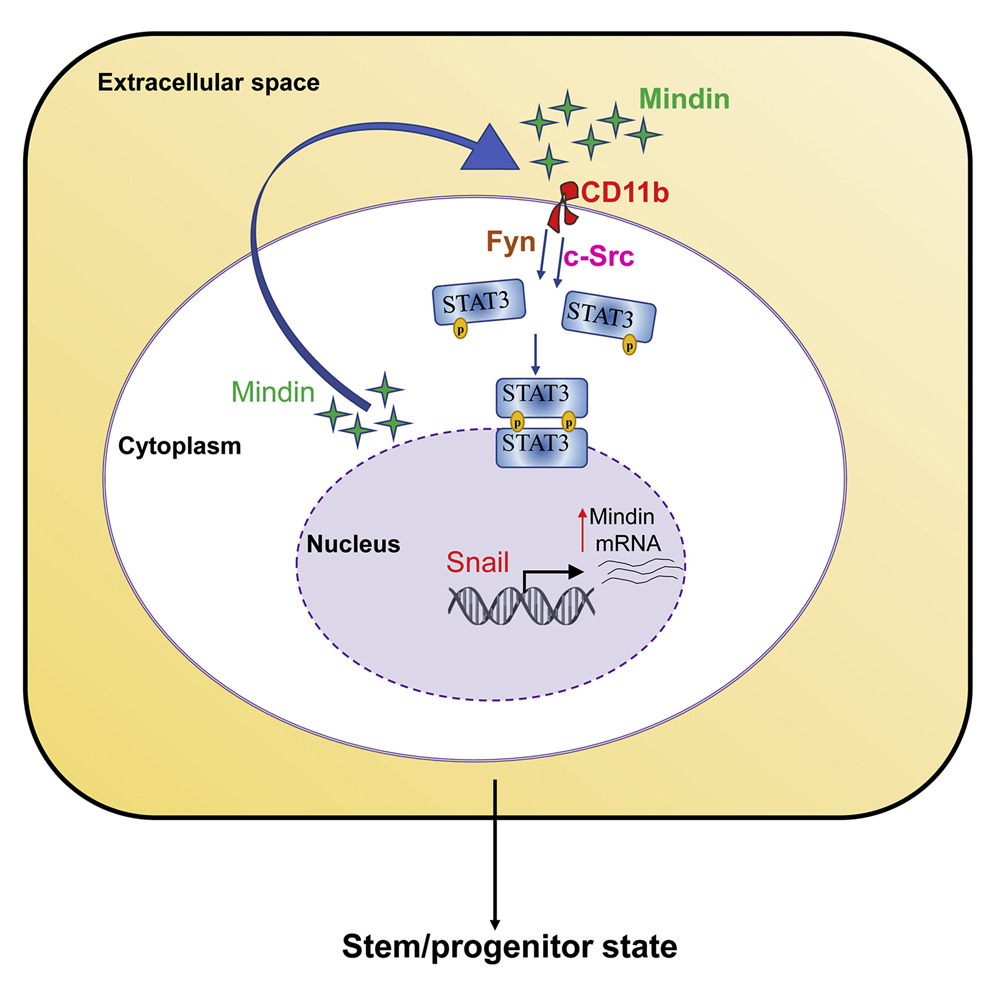
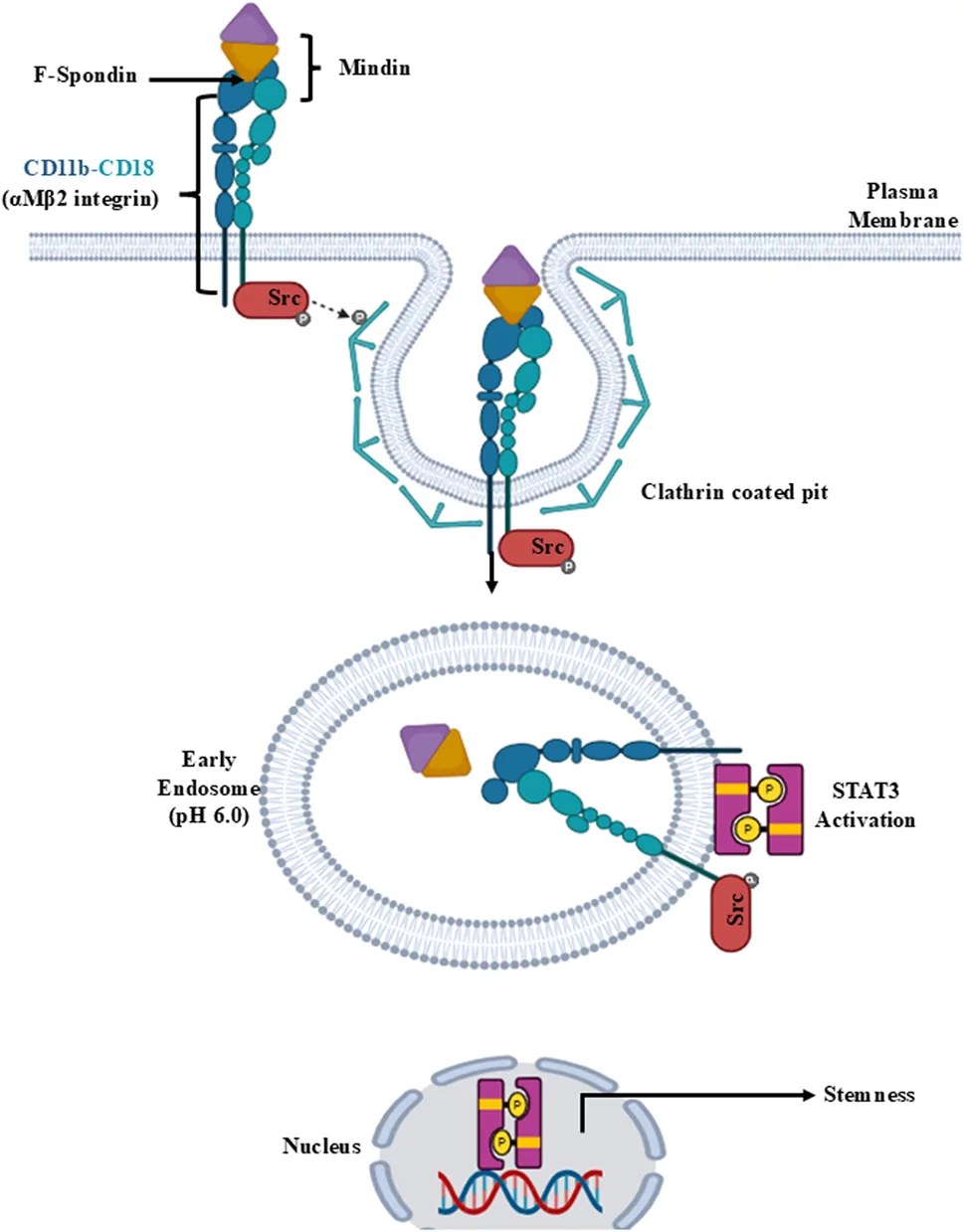
The 2022 model established a Snail-Mindin autocrine circuit that supports epidermal stemness. The 2026 work resolves a downstream mechanism: Mindin engagement drives Src-dependent integrin trafficking to acidic endosomes, enabling STAT3 activation.

2022 Foundation

Diagram showing Snail-driven Mindin production and secretion, Mindin signaling through CD11b with Fyn and c-Src, STAT3 activation, and maintenance of a stem-progenitor state.

Takeaway: Snail-driven Mindin secretion establishes an autocrine circuit that supports stem/progenitor state maintenance.

Figure 1. Snail-Mindin signaling model. Reproduced without modification from Badarinath et al., Snail maintains the stem/progenitor state of skin epithelial cells and carcinomas through the autocrine effect of matricellular protein Mindin, Cell Reports 40, 111390 (2022). © The Author(s) 2022. Licensed under CC BY-NC-ND 4.0.

2026 Mechanistic Extension

Diagram showing Mindin F-Spondin engagement of alphaMbeta2 integrin, Src-dependent endocytosis into acidic early endosomes, STAT3 activation, and keratinocyte stemness.

Takeaway: Mindin-αMβ2 engagement links integrin endocytosis to endosomal STAT3 activation.

Figure 7. Mechanism of Mindin-mediated STAT3 activation. Reproduced without modification from Dam et al., Mindin-mediated αM-integrin endocytosis activates STAT3 to maintain keratinocyte stemness, Cell Communication and Signaling 24, 452 (2026). © The Author(s) 2026. Licensed under CC BY-NC-ND 4.0.

Conceptual Insight

Signaling is spatially encoded

In this system, extracellular ligand engagement is not simply transmitted through a receptor. Integrin trafficking and endosomal context become part of the signaling mechanism itself.


Core Questions

The questions that kept the project alive for me

How is stemness sustained?

I kept coming back to how epidermal cells preserve a stem or progenitor-like state once they are placed in a particular extracellular and signaling environment.

Why do trafficking and signaling matter together?

What made the problem interesting was that trafficking did not feel like a background process. It looked more like part of the signaling architecture itself.

Why is this broadly relevant?

Questions about how states are stabilized in epidermal systems matter well beyond one pathway. They speak to regeneration, plasticity, and disease-associated persistence.


Approach

Experimental frame

I approached this as a signaling problem that had to stay grounded in cell state. That meant keeping extracellular components, trafficking behavior, and downstream activation in the same frame instead of treating them as separate stories.

In that sense, the project reinforces a broader idea running through my work: epidermal states are not simply maintained from within. They are actively shaped by the environment around them.


Associated Outputs

Where this work appears

Primary Output

2026 Cell Communication and Signaling article

Mindin-mediated αM-integrin endocytosis activates STAT3 to maintain keratinocyte stemness.

  • 2026
  • Cell Communication and Signaling
  • Research article
  • Co-author

Related Prior Work

2022 Cell Reports paper

Earlier work in this broader signaling area identified an autocrine Snail-Mindin loop supporting epithelial stem or progenitor-like states.

  • 2022
  • Cell Reports
  • Research article
  • Co-author

Mechanistic Insight

Signaling is spatially encoded

Integrin trafficking and endosomal context are not merely downstream consequences of signaling; they help determine how Mindin engagement is translated into STAT3 activation and sustained keratinocyte stemness. Together with the earlier Snail-Mindin work, this provides a mechanistic link between extracellular context, intracellular trafficking, and epithelial cell-state maintenance.


Related Pages

Other projects in the portfolio

DNMT3A mechanotransduction

A wound-repair project on how physical cues regulate the localization of an epigenetic regulator.

Vitiligo spatial transcriptomics

A translational tissue-analysis project on therapy-associated immune remodeling in patient skin.

Academic profile

Return to the full research overview, publication record, talks, and contact details.

Contact

Interested in signaling, stemness, and epidermal plasticity?

I am especially interested in research settings that connect skin epithelial biology, state maintenance, signaling logic, and regenerative systems, and I am always glad to talk with people thinking along similar lines.

↑ Top